
Perry’s World Knowledge Centre for Shoelaces
Shoelaces eh, what's that all about? Well, where would you be without them?
You'd be nowhere without shoelaces.
Welcome to the world of the shoelace (or shoestring as some parts of the planet have them). So, for your delectation, tonight we have:
Welcome to the world of the shoelace (or shoestring as some parts of the planet have them). So, for your delectation, tonight we have:
1. Why Shoelaces?
Hey, I'm serious. You wouldn't be here if it wasn't for shoelaces and they link the traditions of knots
(sailing, boy scouts, mathematics and parcels etc.) and shoes (fashion and design, walking, sport, technology and industry etc.).
As one of the unsung heroes of technology until now, you owe it to your shoelaces (past, present and future)
and to humanity to educate yourself. Do it now because tomorrow you may trip over them.
2. Cross-culture of shoes and knots
The first point to make is that, as well as their purely functional aspect, shoelaces can be seen both from the perspective of being part of the well established culture of shoes and as a sub-set of the world of knots. These two areas are very different; one about fashion, the other about tradition; one about class and status, the other about function; one about feel the other about process. Shoelaces are therefore of interest because they embody the clash between these very different histories, beliefs and attitudes. Just look at a pair of fashionable laced shoes and you can see these contradictions at work. It is no surprise that at the height of shoe fashion the lace is absent.
A difficulty in agreeing a cultural role for the shoelace is also clear. Cultural references to shoes
are all around us (following in someone's footsteps, the Cinderella story, red shoes etc. etc.).
Cultural references to shoelaces however, are limited to two. Firstly there are the general metaphors associated
with learning to tie shoelaces. e.g. phrases like 'he couldn't even remember how to tie his laces.'
This does provide a useful example for an analysis of learned behaviour, where a complex sequence of steps is learnt
when young and remains a habitual part of ones life. The questions of how this is accomplished, how the information
is stored and how easy it is to modify behaviour or apply it in different circumstances are helped by the
shoelace-tying example, but this isn't taken any further here.
Secondly, there remains the widespread (certainly in western culture) use of the term 'shoestring' to
mean low budget. I suspect this will have developed in the Middle Ages when lace fastenings were associated with the
lower classes and anyone who was anyone had elaborate buckle fastenings. However, the first known reference to
'shewstring' only comes from the early 17th century. The first use of the term as meaning 'low budget' doesn't appear
until the late 19th century. For example, shortly after this A P Valdes uses the phrase 'he speculated on a shoe-string'
in the book The Origin of Thought from 1904.
This brings us to a fuller exploration of the history of the shoelace, where things really start to
get interesting.
3. History
Without any preamble, here is my precis of human development. This isn't pure invention, but is based on a fair amount of research. Obviously as we go back in time the evidence base gets weaker and the accuracy of dates becomes more questionable, but I think the basic point is sound.
Summary of Human History | |
years ago | |
| 400 | Invention of means of making (static) electricity |
| 5,500 | Development of writing |
| 10,000 | Invention of the wheel |
| 250,000 | Learning how to make fire |
| 500,000 | Generally using tools |
| 2,000,000 | Invention of the shoelace |
Up until now the definition of when the first humans existed has traditionally been based on the invention and use of tools (Homus Habilis (i.e. handy man)). But we now know we're not the only animal to use tools, so others have proposed the discovery of how to create fire as a more suitable starting point for human existence. The view I'm suggesting here is that the creation of the shoelace pre-dates other significant inventions, but still acts as a defining moment in the move to becoming a creative manipulator of the environment. The development of the shoelace probably has as great a claim as anything else as the defining moment in starting human history.
This leads directly to the first postulation.
Perry's First Postulation
My argument for this can be summarised by:
1. The evolution of humans is inextricably tied to the move from tree-dwelling to a ground based
existence and the development of an upright posture.
There is, I think, still some debate as to whether this move was caused by or whether it enabled growth
in brain size, but consequent evolutionary development certainly requires this move.
2. This move to upright posture was accompanied by a need to develop protective foot-coverings.
Current wisdom suggests that the earliest foot-coverings were based on tying leaves to the feet
with vines - hence the first versions of shoelaces as created purposeful devices.
3. Subsequent human development will therefore have been reliant on the existence of the shoelace.
So our existence in general, and each of us in particular, would have been impossible without shoelaces.
Pre-shoelace there were no humans.
Perry's Second Postulation
Further than the 1st Postulate, it is interesting to think about a world post-shoelace. Although we've been through a buckles period, a button fastening phase, and are now in an age where other shoelace substitutes exist (elastic, Velcro and zips), none of these are clearly superior technology or likely to supplant the primacy of the shoelace. But will this always be the case?
The 2nd postulation is that the shoelace will become redundant at some time in the future, but that
this will be due to evolutionary change in humans rather than materials technology or footwear fashion. The shoelace
will therefore become not only the defining point for the start of human history (1st Postulation), but its demise
will become a recognised end point. In the future, people (or our successors) will use the term 'Homo Calciligo'
(Shoefastening Man) to refer to this phase in our evolutionary development.
I have looked at whether an extension of the 2nd Postulate is workable, where a shoelace phase of
evolution would apply in all possible worlds. This doesn't currently look feasible since it is possible to
imagine beings, climates, planet surfaces (and indeed liquid or gas based environments) where shoelaces are not required.
Whether this turns out to be the case though, remains to be seen. So for the moment it is possible that a shoelace
period is a defining feature of all intelligent life everywhere in the universe, but this cannot yet be proved.
So next time you bend down to tie your laces, recall that you are engaged in a symbolic act of homage to your ancient ancestors, asserting your membership of a civilised race, and extending the continuum of human existence.
4. Good Shoelace Design
For me, the best in shoe lacing is when the practicalities are combined with a creative aesthetic to produce footwear that says something. The practical aspects include the laces themselves being a positive feature of the design as well as providing a suitable means of fitting the shoe to the foot. This has to be combined with a lacing, threading and eyelet arrangement that flows from the whole design (rather than looking like an afterthought). The shoe itself should reinforce the impression that the approach to lacing is an integral part of the whole design.
Here are a couple of examples. I've kept away from current trainer designs, even though this is where a lot of design effort is
being concentrated.
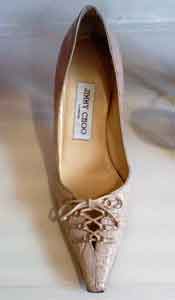
This example by Jimmy Choo shows just how attractive and integral a shoelace can be to the overall design.
It is almost as if the shoe design flows from the lace rather than the lace being just an add-on or a fitting device.
It's also worth pointing out how rare shoelaces are these days in ladies footwear, whilst at the same time remaining dominant in men's. Do your own surveys in shops or on the street, but I'm getting figures of around 90% of women not wearing shoelaces and 90% of men with. I have a sneaking feeling that there is a conspiracy at work. I can't work out why, but there must be a secret Government department behind it all - or it's something to do with aliens.
It is almost as if the shoe design flows from the lace rather than the lace being just an add-on or a fitting device.
It's also worth pointing out how rare shoelaces are these days in ladies footwear, whilst at the same time remaining dominant in men's. Do your own surveys in shops or on the street, but I'm getting figures of around 90% of women not wearing shoelaces and 90% of men with. I have a sneaking feeling that there is a conspiracy at work. I can't work out why, but there must be a secret Government department behind it all - or it's something to do with aliens.

This design icon - the basketball shoe - epitomises the role of the shoelace as a fundamental component of the overall product.
Flat, white, cotton laces in the American lace pattern. How could it be any other way?
Flat, white, cotton laces in the American lace pattern. How could it be any other way?
5. Bad Examples of Shoelaces
The most common quality of shoe and shoelace design is what I would call ordinary. You can see these for yourself in any high street. I'm not going to bore you with any of these, but move straight from my idea of good to that of bad. Here are a couple of examples.
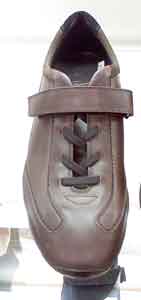 First there is this. Here the so-called shoelace is a length of elastic, sewn on to the shoe. Shoelace it isn't. All adjustment of fit is
just by the strap at the top.
First there is this. Here the so-called shoelace is a length of elastic, sewn on to the shoe. Shoelace it isn't. All adjustment of fit is
just by the strap at the top.This is a shoelace falsehood.
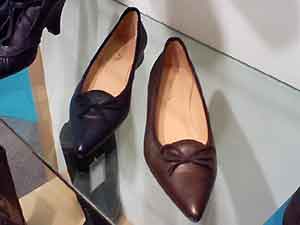 I've lost count of the number of variations on this theme that I've seen, they're everywhere. The shoelace has been reduced to a decorative bow on
the front of the shoe, offering a faint echo of its origins.
I've lost count of the number of variations on this theme that I've seen, they're everywhere. The shoelace has been reduced to a decorative bow on
the front of the shoe, offering a faint echo of its origins.Not a bad shoe, but very bad and condescending treatment of the shoelace.
6. Ugly Examples of Shoe Fastening
Here is one of the greatest insults to the world of shoelaces. They offend me. If I were a shoelace I would cry. Do not let me see you doing anything as cruel as shown in this example.
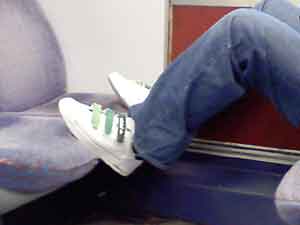 What can I say. Quite a lot probably.
Firstly the trainers are a uniform white and badly shaped.
Secondly the shoelaces have been replaced by three flimsy thin nylon Velcro fasteners threaded through nasty white plastic buckle things.
Thirdly, the Velcro straps come in different shades of gaudy green that prevents any sense of unity.
And finally, they are being worn by someone who thinks it is ok to put their feet up on the seat of the train they are travelling on.
I rest my case. Ugly shoes, ugly shoelace substitutes and poor behaviour. End of rant.
7. Knotting and Lacing issues
So what are the different ways to thread them? Which ways are best? And what does 'best' mean anyway?
And I'm sure you want to make sure your basic knot tying is correct and learn different ways of tying the basic knot.
Then you'll want to delve into the depths of alternative knot technique and solve all your 'shoelaces come undone when I don't want them to' problems.
Watch this video on the Freedom Knot - one of the best
Whilst I could go on (at length) on such topics, the world already has access to such information elsewhere.
Just go to Ian Fieggen's website and spend several hours on an intensive in-depth educational extravaganza.